
Custom Brass Jewelry Lead Times in Days
Every date in a brass order is a published window rather than a promise: under 48 hours for CAD, 25–30 days for the master sample, and 3–4 weeks for bulk. Converted once into days, the shortest credible path from approved concept to delivered carton is 48 days and the longest is 60. Most schedule arguments come from mixing those units.

Key takeaways
- CAD at under 48 hours is 2 days, or 6.7% to 8% of a 25–30 day sampling window.
- Sampling takes roughly half the total calendar: 25–30 days inside a 48–60 day path.
- One extra sample round pushes the total to 73–90 days, because the whole window repeats.
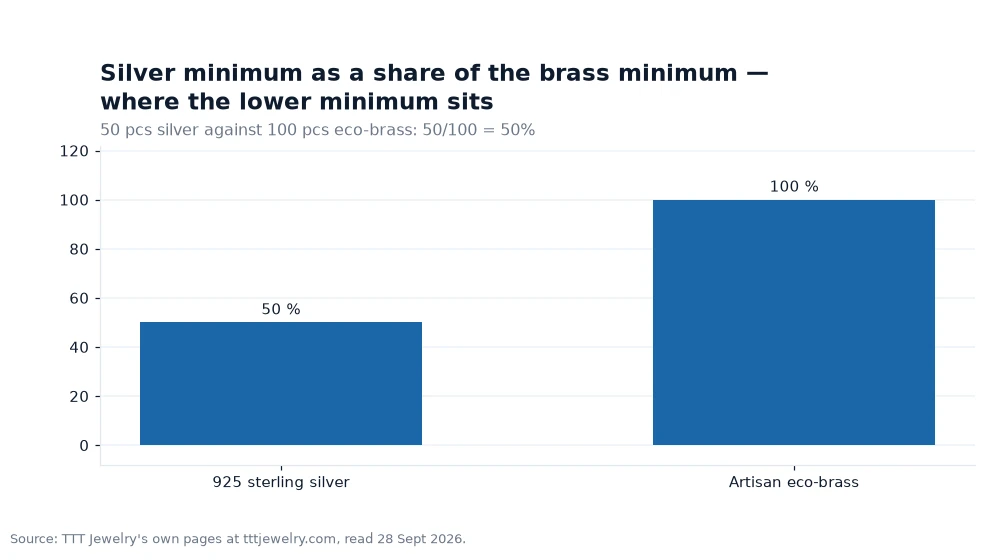
- Brass MOQ is 100 pieces per design against 50 for silver, so design depth changes the unit count.
Four published windows, converted once
The published numbers arrive in three different units, which is where most planning errors start. CAD is quoted in hours, sampling in days, and production in weeks. Converting them to a single unit gives 2 days, 25–30 days and 21–28 days. Add the three blocks and the range is 2 + 25 + 21 = 48 days at the fast end and 2 + 30 + 28 = 60 days at the slow end.
That total assumes the blocks run in sequence, which they do. A sample cannot be approved before it exists, and bulk production cannot start before approval. What can overlap is work on separate designs: five designs can be in sampling at the same time if the factory schedules them that way, but one design cannot compress its own chain by asking for it.
The six-step route that TTT Jewelry publishes follows the same order, from inquiry through consultation, CAD, sample approval, bulk production and final QC. The OEM/ODM jewelry manufacturer page presents those steps as a flow rather than a price list, which makes it useful for calendar work: the blocks are named, and only transit time is left out.
What actually consumes the 25–30 days
The sampling window is not one operation. It contains wax printing, mould casting, stone setting, polishing and custom electroplating, run in that order for a piece that carries stones. Each handoff costs a queue position as well as bench time, which is why the window is measured in weeks rather than in hours of labour.
Stone setting is the stage that most often changes the shape of a design. A setting that needs a seat cut deeper than the casting allows sends the piece back to the mould, and the calendar restarts at casting rather than at polishing. Polishing and plating come last because both are surface operations, and neither can rescue a geometry that is wrong underneath.
For planning purposes the whole 25–30 days should be treated as unavailable, not as a reserve that can be trimmed by chasing. A wholesale brass jewelry factory that quotes a delivery date is usually quoting the full window plus production, and the buyer who plans against the fast end of every range is the buyer who misses the drop.
Why the brass calendar differs from the silver calendar
Material changes the arithmetic at the quantity stage more than at the timing stage. The published MOQ is 100 pieces per design for artisan eco-brass and 50 pieces per design for 925 sterling silver. Silver therefore needs half the units to open a design, but that does not shorten the sample or the production window: the same mould, the same bench time and the same plating passes are needed for a 50-piece run as for a 100-piece one.
Plating is the other difference. Brass takes electrolytic layers of 14K, 18K or 24K gold, or rhodium, followed by anti-tarnish e-coating. Silver takes the same colour menu with its own anti-tarnish treatment, and stainless steel takes PVD instead. A collection that mixes metals is therefore running two or three process routes through one calendar, and each route has its own queue.
The practical effect is on reorder planning rather than on the first order. A brass design at 100 pieces and a silver design at 50 pieces cost the same sampling time, so the smaller silver run spreads that fixed time over fewer units. Buyers comparing the two lines should compare total programme time, not unit time. The sterling silver jewelry manufacturer page sets out the silver side of that comparison, including the 50-piece threshold.
| Stage | Published window | Days | Who holds the clock |
|---|---|---|---|
| CAD and prototype | Under 48 hours | 0–2 | Factory |
| Master sampling | 25–30 days | 25–30 | Factory bench |
| Sample approval | Not published | Buyer's review | Buyer |
| Bulk production | 3–4 weeks | 21–28 | Factory |
| Final QC and dispatch | 100% inspected, then shipped | Transit not published | Shared |
Two rows in that table are deliberately blank in the days column. Sample approval has no published duration because it depends on how quickly a buyer reviews a physical piece, and transit has none because it depends on the destination and the service used. Both belong in the plan, and neither can be derived from the manufacturing figures.
Elapsed time is not bench time
The 25–30 days is a window, not a stopwatch reading of work. A sample spends part of it waiting for a bench slot, part in a wax printer, part on a casting tree and part moving between stations inside the same building. Production behaves the same way: a batch that shares a plating line with other batches waits for its turn at the tank.
This is why a small design change can still cost a month. The edit itself may take minutes in CAD, but behind it sits a fresh prototype, a new cast and another pass through polishing and plating. A custom brass jewelry brief that settles stone positions and finish per surface before tooling removes most of those repeat laps.
None of this is hidden in the published figures. The windows are quoted as whole blocks precisely because the queue is part of the process, and a supplier who quotes a shorter block is usually describing bench time alone.
Worked example
Take a single brass design at the 100-piece MOQ and plan it against the published ranges. CAD is 48 hours, which is 48/24 = 2 days. Sampling is 25–30 days. Production is 3–4 weeks, and at seven days per week that is 21–28 days. The total is 2 + 25 to 30 + 21 to 28 = 48 to 60 days.
Now measure each block against the total. Sampling at 25 days is 25/48 = 52% of the fastest path; at 30 days it is 30/60 = 50% of the slowest. Half the calendar sits in one stage, which is why sample feedback is the most valuable thing a buyer can accelerate.
Add one revision round and the whole sampling window repeats. The total becomes 2 + 25 to 30 + 25 to 30 + 21 to 28 = 73 to 90 days. The extra 25–30 days is not a penalty charge; it is the same sequence of wax printing, casting, setting, polishing and plating run a second time on a corrected design.
Quantity does not change any of those figures. Five designs at 100 pieces each is 500 units, but if the samples run side by side the calendar stays near 48–60 days. Five designs approved one after another multiply the sampling block instead, and that is a scheduling choice rather than a manufacturing limit.
Frequently asked questions
Can a brass order be finished faster than 48 days?
The published blocks add up to 48–60 days, so anything shorter would have to come out of sampling or production rather than out of scheduling.
Does a larger order take longer to produce?
Production is published as 3–4 weeks and varies with batch volume and design complexity, so a larger run sits at the upper end of that window rather than outside it.
Is the 25–30 day sample window per design?
Each design needs its own tooling and its own sample, so the window applies per design, although several designs can be sampled in parallel.
Building a date you can defend
A defensible delivery date starts from the slow end of each published window and then subtracts only what is genuinely parallel. That produces 60 days for a single design before transit, and a plan built on that number survives a revision round without renegotiating the drop.
Collections that mix metals need one date per route rather than one date for the range. It also helps to fix the quantity per design early, because the 100-piece threshold for brass and the 50-piece threshold for silver determine how many units carry the same fixed sampling time. Buyers who want the full route in one place can read the pages behind this article, which list the stages and the thresholds without quoting prices.
Source note: figures come from the manufacturer's own website (tttjewelry.com), read 28 Sept 2026.[1]